
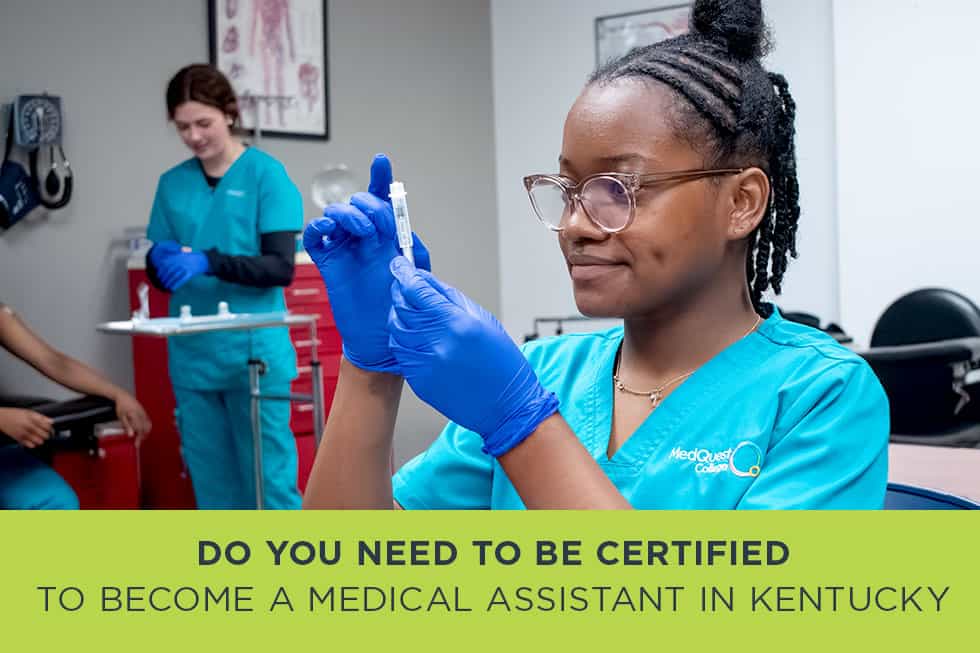
Kentucky does not generally require medical assistants to hold a state-issued license or national certification to work in the profession. However, individual healthcare employers may prefer or require national credentials, such as the Registered Medical Assistant (RMA) or Certified Medical Assistant (CMA). Completing medical assistant training and understanding certification requirements can help you prepare for job opportunities in Kentucky.
If you are considering a career in medical assisting, it is important to understand the difference between state requirements, employer expectations, and national certification. MedQuest College’s 10-month Comprehensive Medical Assisting program, offered at its Louisville and Lexington campuses, combines classroom instruction, hands-on clinical lab practice, and a clinical externship to help students develop relevant knowledge and skills for the field.
What Is the Difference Between Medical Assistant Certification and Licensure?
Medical assistant certification and licensure are different credentials. Licensure is a legal authorization issued by a government agency, while certification is generally awarded by a professional organization after an individual meets its eligibility requirements.
State licensure: Kentucky does not generally issue a state license specifically for medical assistants. The clinical duties a medical assistant may perform depend on applicable laws, regulations, and appropriate supervision or delegation.
National certification: National certification is a professional credential offered by a certifying organization. Candidates must meet the organization’s eligibility requirements and, where required, pass an examination. Examples include the Registered Medical Assistant (RMA) credential offered by American Medical Technologists (AMT) and the Certified Medical Assistant (CMA) credential offered by the American Association of Medical Assistants (AAMA).
Although national certification is not generally mandated by Kentucky law for medical assistants, employers may establish their own education, experience, and credential requirements. Anyone planning to enter the field should review job postings and the current requirements of the credential they hope to pursue.
Why Do Employers Look for Certified Medical Assistants?
Medical assistants support healthcare teams with administrative and clinical responsibilities. Depending on the workplace and their assigned duties, they may help prepare patients for appointments, record vital signs, maintain medical records, collect specimens, perform certain diagnostic procedures, and assist with routine office operations.
Some employers prefer or require nationally certified medical assistants when hiring. Requirements vary by employer, position, and healthcare setting.
Here are a few reasons an employer may value professional certification:
- Demonstrated knowledge: A national credential can indicate that a candidate has met a certifying organization’s requirements, which may include education, experience, and examination.
- Preparation for clinical responsibilities: Medical assisting education can introduce students to topics such as vital signs, phlebotomy, electrocardiography (EKG), medical terminology, and patient care procedures.
- Professional development: Pursuing certification can provide a structured way to demonstrate knowledge and continue developing professionally.
- Employer qualifications: Some healthcare organizations include a specific certification in their hiring criteria. Reviewing job postings can help prospective students understand which credentials may be relevant to their career goals.
Certification does not automatically guarantee employment or authorize a medical assistant to perform every clinical procedure. Responsibilities depend on applicable requirements, the employer’s policies, training, and appropriate supervision.
How Does MedQuest College Prepare Students for the RMA Exam?
MedQuest College’s Comprehensive Medical Assisting program is designed to provide students with classroom instruction, clinical lab experience, and an externship. Eligible graduates can apply to take the Registered Medical Assistant (RMA) examination through American Medical Technologists (AMT), subject to the organization’s current eligibility requirements.
The 10-month program is offered at MedQuest College’s Louisville and Lexington campuses and includes three key areas of learning.
1. Classroom Instruction
Students build a foundation in topics relevant to medical assisting, including medical terminology, anatomy and physiology, pharmacology, patient care, and medical office administration. Coursework also introduces important professional responsibilities, such as protecting patient information and understanding healthcare procedures.
This knowledge can help students understand how clinical and administrative duties fit into the daily operations of a medical practice.
2. Supervised Clinical Lab Practice
Hands-on lab activities allow students to practice skills in an instructional environment under appropriate supervision. Training may cover clinical procedures and techniques such as:
- Vital signs: Learning how to measure and document information such as blood pressure, pulse, and temperature.
- Phlebotomy and specimen handling: Studying proper collection techniques and procedures for handling specimens.
- Electrocardiography (EKG): Learning about EKG equipment, lead placement, and recording cardiac electrical activity.
- Medication-related procedures: Studying relevant calculations, techniques, and safety practices within the program’s scope of training.
Clinical procedures must be performed in accordance with applicable requirements and under the appropriate level of supervision. Classroom and lab instruction provide opportunities to develop knowledge and practice techniques before applying relevant skills in a clinical setting.
3. Clinical Externship
The program includes a clinical externship that gives students an opportunity to apply their training in a healthcare environment under professional supervision. An externship can help students become familiar with workplace routines, communication with healthcare professionals, patient interactions, and the responsibilities involved in supporting a medical team.
Together, classroom instruction, lab practice, and externship experience provide a structured foundation for students preparing to enter the medical assisting field.
Medical Assistant School vs. On-the-Job Training
Some people begin learning medical assisting duties through workplace training, while others choose a formal educational program. The best route depends on the person’s goals, the employer’s requirements, and the certification they may want to pursue.
A formal program offers a structured curriculum, while workplace training may focus on the duties required at a particular practice. Neither route guarantees certification or employment.
| Preparation area | Formal medical assisting program | On-the-job training |
| Learning structure | Follows an organized curriculum covering relevant clinical and administrative topics. | Typically focuses on the duties and procedures used by a specific employer. |
| Clinical practice | Provides supervised lab practice and, where included, an externship. | Training opportunities depend on the employer, the role, and available supervision. |
| Certification eligibility | May provide an education pathway that meets a certifying organization’s eligibility requirements. | Eligibility depends on the certifying organization’s rules and the individual’s education or work experience. |
| Range of topics | Can cover medical terminology, patient care, office administration, and other medical assisting subjects. | The scope of training may vary according to the practice’s needs and the employee’s responsibilities. |
| Learning environment | Combines instruction with structured opportunities to practice relevant skills. | Takes place within the workflow and procedures of the workplace. |
For students who want structured instruction and supervised practice, MedQuest College’s Comprehensive Medical Assisting program offers a defined educational pathway. Prospective students should compare program content, scheduling, costs, and certification eligibility when deciding how to prepare for a medical assisting career.
How Does MedQuest College Help Medical Assisting Students Prepare for Employment?
Completing medical assistant training is an important step, but preparing to search for a job is another part of the process. MedQuest College supports students through Career Services, which helps them develop professional skills and prepare for the transition from school to the workplace.
MedQuest College also builds relationships with local healthcare employers and helps graduates secure job placements. Career Services remains available after graduation to help alumni explore employment opportunities in their field.
This support gives students additional resources as they begin their job search, complementing the classroom instruction, clinical lab practice, and externship experience included in the Comprehensive Medical Assisting program. Although employment is not guaranteed, students can use these resources to prepare for interviews, present their skills, and explore opportunities in the healthcare field.
Frequently Asked Questions About Medical Assistant Certification in Kentucky
Do you need to be certified to become a medical assistant in Kentucky?
No. Kentucky does not generally require medical assistants to hold a state-issued license or national certification to work in the role. However, individual employers may prefer or require national certification, so reviewing job requirements can help you understand the qualifications expected for particular positions.
Which certification can MedQuest College medical assisting graduates pursue?
Eligible graduates of MedQuest College’s Comprehensive Medical Assisting program can apply to take the Registered Medical Assistant (RMA) examination offered by American Medical Technologists (AMT). Candidates must meet the organization’s current eligibility requirements.
How long is the Medical Assisting program at MedQuest College?
MedQuest College’s Comprehensive Medical Assisting program is designed to be completed in 10 months. It is offered at the college’s Louisville and Lexington campuses.
Does medical assistant training include hands-on experience?
MedQuest College’s Comprehensive Medical Assisting program includes clinical lab practice and a clinical externship. These experiences give students opportunities to practice relevant skills and apply their learning in supervised educational and healthcare settings.
What is the difference between an RMA and a CMA?
RMA stands for Registered Medical Assistant, a credential offered by American Medical Technologists (AMT). CMA stands for Certified Medical Assistant, a credential offered by the American Association of Medical Assistants (AAMA). Each organization establishes its own eligibility and examination requirements, so candidates should review the current rules for the credential they want to pursue. In Kentucky, CMA can also refer to a Certified Medication Aide, which is a different healthcare role from a Certified Medical Assistant.
Does MedQuest College offer morning or evening class schedules?
MedQuest College offers flexible block scheduling options, with available sessions varying by campus and seat availability. Prospective students can ask the admissions team about current scheduling options at the Louisville or Lexington campus.
How to Prepare for Medical Assistant Certification in Kentucky
Although national certification is not generally required by Kentucky law for medical assistants, it may be an important consideration when planning your education and career. Understanding employer expectations, researching certification options, and choosing a training pathway that fits your goals can help you make an informed decision.
MedQuest College’s 10-month Comprehensive Medical Assisting program combines classroom learning, supervised clinical lab practice, and a clinical externship at its Louisville and Lexington campuses. The program is designed to help students develop foundational medical assisting knowledge and prepare eligible graduates to pursue the RMA credential.
Ready to explore medical assisting training in Kentucky? Visit MedQuest College’s Comprehensive Medical Assisting program page to learn more about the program, ask about available class schedules, and explore the next steps toward your education.