
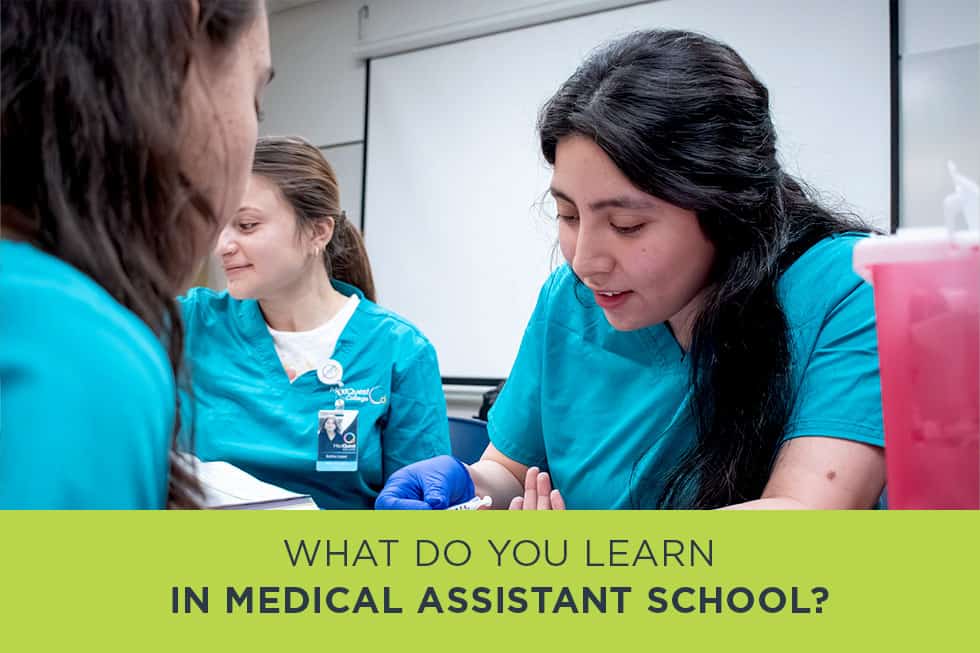
Medical Assistant school typically teaches a combination of clinical, administrative, and professional skills. Students may study subjects such as anatomy, medical terminology, medical billing, medical records, clinical procedures, laboratory procedures, pharmacology, and healthcare law. Hands-on training and an externship help students apply what they learn in settings that reflect the daily operations of a medical office.
When evaluating these programs, a primary question often emerges: What do you learn in medical assistant school? The curriculum is designed to build a dual skill set, blending technical clinical procedures with administrative tasks to ensure graduates understand the full scope of an ambulatory care setting.
At MedQuest College, our 10-month Comprehensive Medical Assisting program balances classroom lectures, on-campus laboratory practice, and a real-world clinical externship. Available at both our Louisville and Lexington campuses, this structured framework teaches you the required healthcare disciplines from the ground up. In this guide, we break down the specific subjects, clinical procedures, and administrative systems covered throughout the curriculum.
What Subjects Are Taught in Medical Assisting School?
The academic portion of the program builds the theoretical foundation necessary to perform safely in a medical environment. Before you can accurately assist a physician or collect a patient sample, you must understand how the body works.
Foundational Coursework
- Anatomy and Physiology: Students examine the structural components and functional systems of the human body. This coursework details how organ systems interact, allowing you to recognize normal body functions and understand why specific clinical symptoms occur.
- Medical Terminology: Learning the language of medicine is essential for professional communication. You will learn to break down medical roots, prefixes, and suffixes, enabling you to read physician notes, document patient charts, and interpret laboratory orders accurately.
- Infection Control: Safety is the primary priority in any medical facility. Coursework covers the chain of infection, proper hand hygiene protocols, and the guidelines for using Personal Protective Equipment (PPE) to maintain a sterile clinical environment.
- Patient Privacy and Documentation: Students study the legal frameworks governing patient data, with a heavy emphasis on Health Insurance Portability and Accountability Act (HIPAA) compliance. You will learn the legal rules of charting and how to protect sensitive patient records from unauthorized access.
Which Skills Are Practiced in a Lab and What Clinical Procedures May Students Learn?
Textbook knowledge alone is not enough to build clinical competence. A major portion of your time at MedQuest College is spent inside our dedicated on-campus clinical labs. These spaces mirror actual medical offices, allowing you to practice technical tasks under the direct supervision of experienced instructors.
Hands-on Clinical Skills and Procedures
- Taking Vital Signs: Students practice patient triage protocols by learning to measure and record accurate baseline metrics, including blood pressure, heart rate, respiration rate, and body temperature.
- Phlebotomy: You will learn the anatomical placement of veins and practice venipuncture techniques. The lab covers how to practice drawing blood safely, handle vacuum tubes in the correct order of draw, and apply proper post-puncture care.
- EKG Administration: Instructors walk you through the precise placement of electrodes for a 12-lead Electrocardiogram (EKG). You will learn to operate the equipment to capture clean heart rhythm data for physician review.
- Specimen Collection: Students practice collecting and preparing various diagnostic samples, such as performing urinalysis strip tests or processing throat swabs for laboratory evaluation.
- Preparing Exam Rooms: You will practice setting up examination spaces between mock patient visits, ensuring all surfaces are sanitized, appropriate instruments are laid out, and standard biohazard disposal protocols are followed.
- Assisting with Procedures: The lab environment allows you to practice assisting an instructor or classmate with minor office procedures, such as preparing surgical trays for suture placement or removal.
- Medication Administration: You will practice calculating correct dosages and safely administering medications, including oral medications as well as the specific injection techniques (such as intradermal, subcutaneous, and intramuscular injections) that medical assistants are trained to perform.
What Administrative Skills Are Included?
Medical assistants are frequently the first point of contact for patients, making the administrative component of the curriculum just as vital as clinical care. A smooth-running front office is critical for efficient patient workflows and accurate facility operations.
Administrative Competencies
- Electronic Health Records (EHR): Students train on current healthcare software systems to learn how digital medical charts are created, updated, and stored. You will practice entering patient data into digital records without administrative error.
- Scheduling: You will learn how to manage appointment schedules, balance urgent care pop-ins with routine physical checkups, and minimize scheduling gaps to keep the facility running on time.
- Insurance and Billing Basics: The curriculum introduces the foundational structures of health insurance policies, pre-authorization processes, and the primary coding systems used to document diagnoses and treatments for insurance reimbursement.
- Patient Intake: Students practice checking patients in, verifying insurance eligibility, collecting co-pays, and gathering initial demographic data accurately.
What Professional and Patient-Communication Skills Are Developed?
Technical capability must be paired with strong interpersonal skills. Medical assistants interact with patients who may be anxious, injured, or facing stressful diagnoses, requiring a professional and measured approach.
Professional Skills Development
- Patient Communication: You will practice active listening techniques and learn how to explain complicated medical instructions or preparation guidelines in clear, accessible language.
- Attention to Detail: In healthcare, a minor clerical or measurement error can alter a patient’s care plan. The program emphasizes strict precision when recording documentation, reading medication labels, and tracking lab labels.
- Teamwork: Medical offices rely on interdisciplinary collaboration. You will practice working alongside instructors and fellow students, simulating the coordination required between medical assistants, nursing staff, and physicians.
- Time Management: Balancing front-office tasks with back-office clinical needs requires the ability to prioritize tasks efficiently throughout a shift.
- Confidentiality: Professionalism means keeping patient discussions and charts restricted solely to appropriate medical staff, reinforcing ethical standards daily.
How Does an Externship Reinforce Classroom Learning?
The final component of the Comprehensive Medical Assisting curriculum at MedQuest College is the required clinical externship. This component places you directly into a local medical facility, such as an outpatient clinic or private family practice, to work under professional supervision.
Applying Skills During an Externship
The externship helps bridge the gap between classroom and lab learning and the day-to-day environment of a medical office. Instead of working with mock setups, you will apply your skills to actual clinical workflows.
This phase of your education allows you to:
- Transition your lab-tested techniques into real-time patient care scenarios.
- Adapt to the fast-paced daily schedules and communication habits of a professional team.
- Build direct experience navigating different software systems and clinic floor plans.
- Receive direct evaluation and feedback from practicing medical professionals.
How Does Medical Assisting Training Differ from Learning Solely on the Job?
While some individuals attempt to enter the healthcare workforce without formal schooling, a structured education offers learning through a structured curriculum, rather than attempting to learn solely on the job.
Completing a comprehensive, accredited Medical Assisting program lays the foundation for earning nationally recognized credentials, such as the Certified Medical Assistant (CMA) offered by the American Association of Medical Assistants (AAMA) or the Registered Medical Assistant (RMA) offered by American Medical Technologists (AMT). Across the healthcare industry, a growing number of clinical facilities and outpatient medical offices now require applicants to hold a recognized certification as a prerequisite for employment. Completing formal training ensures you possess the verified knowledge and clinical credentials modern healthcare employers look for.
| Aspect of Preparation | Formal Medical Assisting School | Learning Solely on the Job |
| Comprehensive Scope | Covers both clinical and administrative paths thoroughly from day one. | Often limited to the immediate, specific tasks needed by that single employer. |
| Controlled Environment | Allows you to practice venipuncture and EKGs safely in a lab setting before working with patients. | Training may take place in a working medical environment, where there may be less time for repeated practice or step-by-step instruction. |
| Structured Foundation | Provides deep modules in anatomy, medical terminology, and HIPAA law. | Relies on piecemeal learning, which can lead to gaps in regulatory compliance knowledge. |
| Institutional Review | MedQuest College is accredited by the Accrediting Bureau of Health Education Schools, an accrediting agency recognized by the U.S. Secretary of Education | Unregulated training quality that varies drastically depending on the staff’s available time. |
Formal school ensures that you build confidence before working with patients, before you assume responsibility in an active healthcare environment.
Frequently Asked Questions (FAQs)
Q: Do I need any medical prerequisites before enrolling in the Medical Assisting program?
A: Prior medical experience is not required to begin the program. Applicants must still meet MedQuest College’s current admissions requirements, so prospective students should speak with Admissions for complete eligibility information.
Q: Do you offer day and evening classes?
A: Yes, MedQuest College offers multiple class schedule options to assist students who are balancing family duties or other personal responsibilities. Depending on local campus options and seat availability, we provide morning sessions (8:00 AM to 12:00 PM), afternoon sessions (1:00 PM to 5:00 PM), and evening sessions (6:00 PM to 10:00 PM).
Q: Are the textbooks, uniforms, and laboratory supplies included in the cost of tuition?
A: Program costs include separate charges for tuition, books, supplies, and fees. According to MedQuest College’s current catalog, Medical Assisting program fees include items such as medical lab materials, safety equipment, three sets of uniforms, a background check, CPR certification, AMT membership, and the RMA certification examination. Students should speak with Admissions for the most current cost and inclusion details.
Q: What certifications can graduates pursue after completing the program?
A: Graduates who successfully complete the program and meet all course requirements are prepared and eligible to take the American Medical Technologists national certification examination. Those who pass earn the Registered Medical Assistant, RMA (AMT), credential.
Build Your Educational Foundation
Understanding what you learn in medical assistant school reveals a well-rounded curriculum that prepares you for both sides of the medical office. From taking accurate vital signs in the clinical lab to managing digital patient files in the front office, the training provides an efficient path toward building clinical competence.
At MedQuest College, our 10-month program is structured to guide you through every phase of this learning process with experienced faculty, dedicated lab spaces, and regional externship opportunities.
Are you ready to explore our medical assisting classrooms? Visit our Comprehensive Medical Assisting program to request information or arrange a personalized tour of our Louisville or Lexington campuses today.